What on Earth Is a Lethaby?
Posted on May 17, 2026
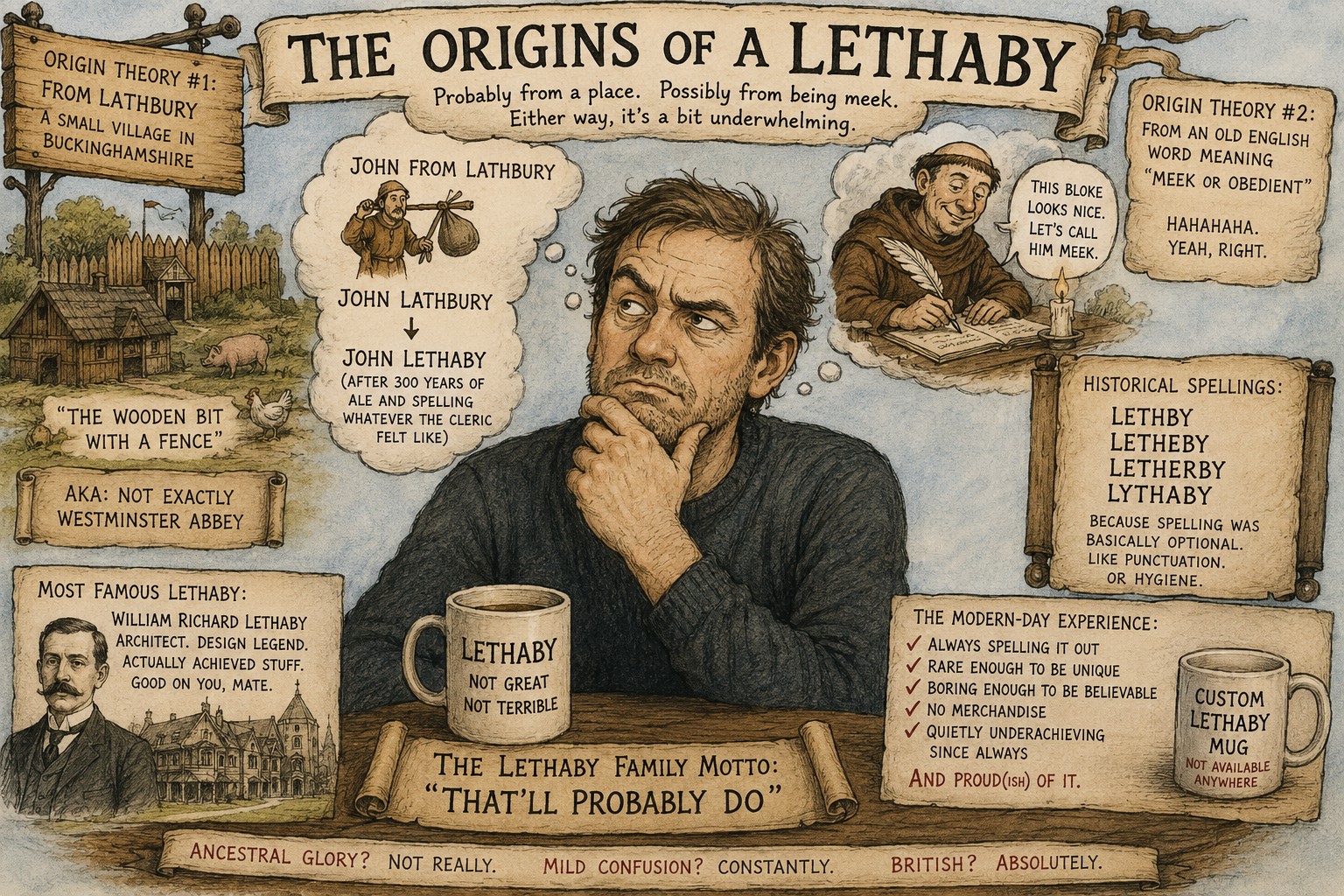
Thanks to the recent national outbreak of people loudly banging on about “heritage,” “traditional values,” and “our proud Christian roots” usually while standing in a queue for an Indian meal or shouting abuse at a Deliveroo cyclist, I found myself wondering whether I should probably learn something about my own surname.
Not because I’ve suddenly become deeply spiritual or patriotic, obviously. I simply realised that if civilisation continues collapsing into podcasts hosted by divorced maniacs, it might eventually become socially compulsory to know where your ancestors came from.
And when your surname is Lethaby, people assume one of two things: either you’re descended from minor Viking nobility, or your family used to repair leather furniture in Bodmin.
Disappointingly Unglamorous
The truth, disappointingly, appears to be even less glamorous than that.
If your surname is Smith, Jones, Taylor or Brown, life is fairly straightforward. Your name appears on mugs in gift shops, novelty pencils, tea towels, and those deeply suspicious “ancient family history” scrolls sold online by men called Nigel for £14.99 (per month) plus postage.
If your surname is Lethaby, however, you spend a surprising amount of your life sounding like you’ve invented it during a panic attack.
“No, not Leatherby.”
“No, not Lethebee.”
“Yes, there’s an ‘h’ in it.”
“No, I don’t know where it comes from.”
“No, I’m not Scandinavian.”
“How many more times do you want me to spell it, for fucks sake?”
No Clans or Dukes
Being a Lethaby means belonging to one of Britain’s most aggressively mediocre surnames. We’re not aristocracy. There’s no Clan Lethaby tartan, no grand estate, no ruined abbey, and certainly no dukes lurking in the family tree. If anything, the family crest is probably just a damp receipt and a mildly disappointed expression.
Frankly, if you meet another Lethaby in the wild, there’s about a 40% chance they’re a cousin and a 60% chance one of you has misheard the other.
So where the hell does the name actually come from?
The strongest theory is that Lethaby evolved from Lathbury, a village in Buckinghamshire. Like many English surnames, it probably started as a place-name. Back in medieval England, if you left your village and wandered more than twelve miles away, people treated you like you’d returned from fucking Narnia.
So if someone called John turned up in another town, people would identify him as “John from Lathbury,” which gradually became John Lathbury, and eventually John Lethaby after several centuries of illiteracy, ale consumption, and exhausted church clerks doing their best.
Medieval Bureaucracy
That’s genuinely how half of English surnames happened. There was no majestic moment of naming. Just tired medieval bureaucracy.
The original place-name is thought to come from Old English words meaning something along the lines of a timber-built fortified settlement.
Which sounds impressive until you realise it basically translates to:
“The wooden bit with a fence.”
Not exactly Camelot, is it?
Still, that’s England for you. We romanticise everything now, but most ancient settlements were probably just three huts, a pig, and someone shouting about turnips.
There’s also another theory that Lethaby comes from an old Middle English term meaning meek or obedient.
Which honestly feels like complete bollocks.
No family survives centuries in Britain by being meek and obedient. British family history is generally held together by stubbornness, low-level resentment, and people refusing to move house out of spite.
Still, perhaps there was one unusually agreeable medieval Lethaby who permanently ruined the family reputation for the rest of us.
One of the joys of old surnames is that spelling was effectively optional for hundreds of years. Medieval scribes wrote names however they sounded, depending largely on accent, education level, and presumably how hungover they were.
Which explains why historical records contain variations like Lethby, Letheby, Letherby and Lythaby.
At this point it’s honestly amazing anyone inherited property instead of accidentally giving the farm to a bloke called Keith.
Why So Rare?
This also explains why modern Lethabys are relatively rare. Somewhere along the line, entire branches of the family probably wandered off under different spellings and disappeared forever into the bureaucratic soup of British history.
There are almost certainly distant relatives walking around today called something like “Leatherbee” who have absolutely no idea what happened.
The most famous bearer of the name was William Richard Lethaby, an architect and major figure in the Arts and Crafts movement. Every obscure surname desperately needs one historically competent person attached to it. Otherwise historians are left concluding:
“The Lethabys appear to have spent several centuries quietly underachieving.”
Which, if I’m honest, feels painfully on brand for me personally.
I’m not saying the family motto should be “That’ll probably do”, but it would explain a lot.
So the name Lethaby probably began as a geographical label attached to someone from a muddy little settlement with wooden fortifications, before slowly mutating through the centuries into the version we have now.
Ancient origins. Questionable spelling. Mild confusion. Absolutely no gift-shop representation whatsoever.
That’ll do.
Got something to say?