Nigel Farage and the Great Victimhood Hokey Cokey
Posted on July 7, 2026
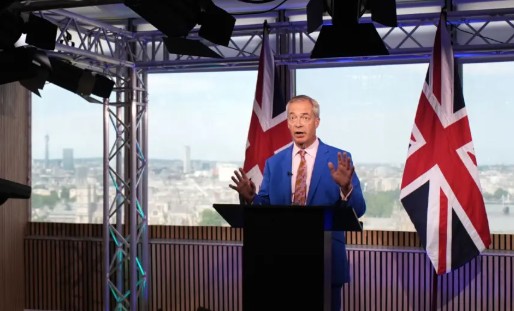
Nigel Farage resigning as an MP so he can stand again as an MP is one of those political moves that makes you wonder whether democracy has become a poorly organised village panto.
He is stepping down in Clacton, triggering a by-election, then standing in that same by-election, all while presenting himself as a brave man of the people taking on the establishment, the media, rival parties, parliamentary standards, probably the BBC weather app, and anyone else who has had the nerve to ask him awkward questions. Farage says the voters should decide his fate, after scrutiny over undeclared financial support and gifts.
Fair enough. Voters do get to decide. That is how elections work. However, the dark comedy comes from the fact that he appears to want the voters to decide before anyone else is allowed to finish asking the questions.
It is like being stopped for speeding, then demanding the whole village votes on whether speed cameras are part of a deep-state plot.
The Press Conference Without Much Press
One of the funniest, and most revealing, parts of this whole circus is that Farage’s big moment was described as a statement or broadcast rather than a normal press conference where media organisations could properly get stuck in. Reuters described it as a televised statement in which he attacked media intrusion and the political establishment.
Which is handy, isn’t it?
If you are furious with the media, the last thing you want is the media asking questions. That would be terribly inconvenient. Much better to stand in front of the cameras, say your piece, blame everyone else, then disappear before anyone can ask something deeply unfair, such as: “Can you explain the money?”
Calling that a press conference is a bit like calling a locked toilet a public convenience.
Scrutiny Is Fine Until It Happens to Me
This is where the narcissistic behaviour comes in.
Not as a medical diagnosis. I am not saying Farage has a personality disorder. I am saying this is the classic narcissistic style we see in public life all the time.
When they attack others, it is scrutiny.
When others scrutinise them, it is persecution.
When they ask questions, they are brave truth-tellers.
When they are asked questions, it is a witch hunt.
When they make allegations, they are standing up for ordinary people.
When allegations are made about them, it is the establishment trying to silence the revolution.
It is the political equivalent of throwing a brick through a greenhouse, then crying because someone mentioned broken glass.
From “Explain This” to “They’re Out to Get Me”
The questions around Farage are not complicated. They are not mysterious riddles carved into an ancient cave wall.
They are basically this:
Who gave you money?
What was it for?
When did they give it to you?
Should it have been declared?
Did you follow the rules?
That is not the establishment trying to destroy democracy. That is basic accountability. It is the sort of thing you would expect from anyone in public office, whether they are a party leader, a parish councillor, or the bloke in charge of ordering new cones for roadworks.
Yet Farage has turned it into a grand battle between the people and the establishment. He has accused the political class and media of targeting him and Reform UK, while insisting the public should decide.
And this is the trick. He moves the argument away from the facts and turns it into a loyalty test.
You are no longer being asked to consider whether he has questions to answer. You are being asked whose side you are on.
Nigel or the establishment.
The people or the press.
Reform or the swamp.
It is not politics anymore. It is emotional hostage-taking with a rosette on.
The Man Who Is Always the Victim
Farage has made a long career out of being the man who says what others are supposedly too scared to say. He attacks politicians, journalists, civil servants, migrants, Brussels, banks, courts, regulators and anyone who looks like they might own a lanyard.
That is his brand. Attack. Attack again. Then have a pint.
Yet the moment the torch is turned back on him, he becomes the victim. Suddenly, the big loud man who has spent years kicking lumps out of everyone else is a delicate flower wilting under the cruel glare of scrutiny.
It is a remarkable transformation.
One minute he is the fearless outsider.
The next minute he is Bambi in a blazer.
The By-Election as a Get-Out Card
By resigning and standing again, Farage is trying to turn a standards issue into a popularity contest.
That is clever. Darkly clever, but clever.
If he wins, he will claim he has been cleared by the people. Never mind whether the investigations are finished. Never mind whether the questions have been answered. He will say the voters have spoken, case closed, establishment humiliated, pint poured.
If he loses, he can say the system got him. The media poisoned the well. The establishment stitched him up. The usual script can be dusted off, reheated, and served with a garnish of outrage.
Either way, the story stays exactly where he wants it.
On Nigel Farage.
The Real Narcissist Trick
The classic narcissistic move is not simply thinking highly of yourself. Plenty of politicians manage that before breakfast.
The real trick is refusing to accept that rules, questions and consequences apply to you in the same way they apply to everyone else.
It is the belief that your motives are always pure, your enemies are always corrupt, your supporters are always the real people, and any criticism of you is really an attack on them.
That is what makes this whole thing so grimly funny.
Farage does not appear to be saying: “There are questions, and I will answer them.”
He appears to be saying: “There are questions, and the fact you are asking them proves I am right.”
That is not accountability. That is a magic trick for people who want politics to feel like a pub argument at closing time.
Welcome to the Nigel Show
The depressing thing is that it might work.
Farage knows exactly how to turn scrutiny into fuel. He understands grievance better than most politicians understand their own manifestos. He knows that a certain type of voter does not need him to be clean, only to be attacked by the right people.
So the questions about money become less important than who asked them.
The rules become less important than who enforces them.
The facts become less important than the feeling.
And the feeling he wants to create is simple: they are coming for me because I speak for you.
That is powerful. It is also absolute nonsense.
Sometimes, Nigel, they are not coming for you because you are dangerous to the establishment.
Sometimes they are asking questions because you are an MP and that is how public life is supposed to work.
Final Thought
Nigel Farage resigning and re-standing is being sold as defiance. To me, it looks more like a man trying to jump over the accountability queue while shouting that the queue is run by Marxists.
It is funny, in a bleak way. Like watching someone set fire to their own shed, then go on television to blame the council, the neighbours, the media, the EU, and a bloke from the parish newsletter called Keith.
The voters of Clacton may well send him back to Parliament. That is their right.
However, if they do, it should not be confused with innocence, vindication, or proof of an establishment plot.
It will simply mean he won a by-election.
The questions will still be there, sitting quietly in the corner, waiting for someone to answer them.
Got something to say?