Britain Wants Everything. It Just Doesn’t Want to Pay for It.
Posted on October 7, 2026
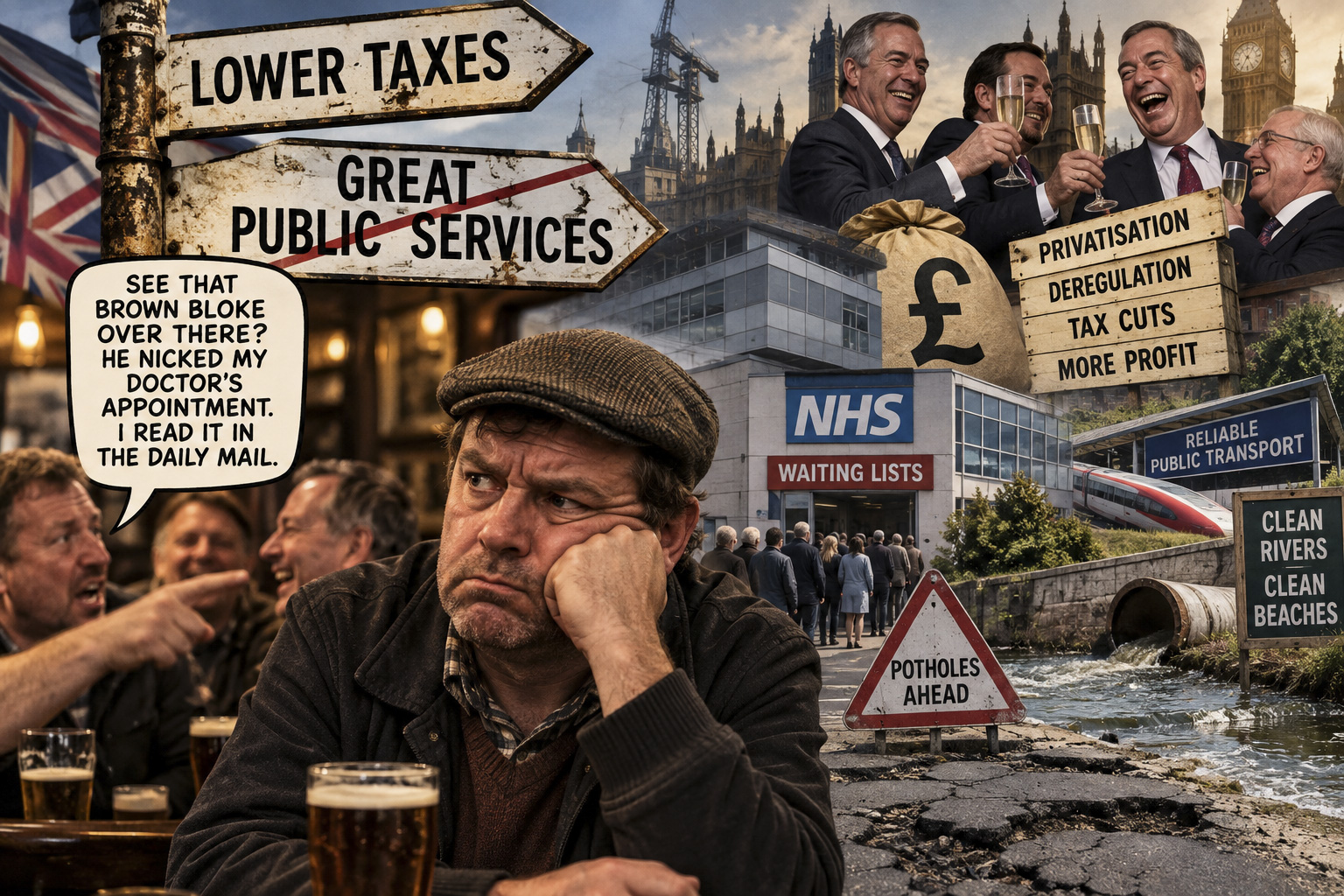
There is a strange British obsession with tax. We don’t just dislike paying too much of it, which is perfectly reasonable, we seem to have reached the point where taxation itself is regarded as some sort of government-sponsored mugging.
I’m All Right, Jack
This attitude didn’t appear overnight. Since the great surge of individualism in the Thatcher years, we have steadily been encouraged to think of tax primarily as money being taken from us, rather than money being collected for us. Keep more of your own money, look after yourself, let the market sort things out and remember that private enterprise always knows best. I’m all right, Jack.
The Conservatives sold variations of that message for decades and Reform now appear to want to take it to another level. The political success of it has been so complete that Labour has repeatedly shifted towards the economic right simply to remain electorally competitive.
There is, however, one rather irritating problem. There is no such thing as excellent public services that nobody pays for.
Who’s Going to Fill the Potholes?
I regularly hear people complaining about potholes, NHS waiting lists, policing, schools, social care and public transport, sometimes within thirty seconds of complaining about tax. “Look at the state of that bloody road. Taxed to death in this country.” Who exactly are we expecting to repair it? The Pothole Fairy?
This contradiction has created fertile ground for another great political fantasy. Apparently, if we could just slash regulation, privatise a bit more and release entrepreneurs from the suffocating tyranny of health and safety, employment protections and environmental legislation, Britain would explode into economic life. Growth everywhere, money cascading from the heavens and potholes filling themselves through sheer entrepreneurial enthusiasm.
The Great Deregulation Fantasy
Of course, bad regulation can be expensive and bureaucratic and governments should constantly review it. But most regulation exists because history repeatedly demonstrated what happens when businesses are left entirely to themselves. People get exploited, people get hurt and the environment gets trashed while a very small number of people become spectacularly wealthy.
The same applies to privatisation. Listen to someone such as Mick Lynch explaining how money flows through Britain’s fragmented railway system and he is often portrayed as some wild-eyed Marxist firebrand. Yet asking where billions of pounds actually go seems a fairly reasonable question.
The same applies to water. Point out that shareholders and executives have done extremely well while sewage has been discharged into rivers and coastal waters and suddenly you’re a bleeding-heart leftie who doesn’t understand economics. I understand enough economics to know that if I’m paying a private company to deal with sewage, I’d quite like them to deal with the sewage. Apparently this is now revolutionary socialism.
What Sort of Country Do We Actually Want?
The depressing thing is that none of this is irreversible. Britain remains an enormously wealthy country and we could choose better healthcare, social care, public transport, cleaner rivers and properly maintained infrastructure. But we would have to have an adult conversation about paying for it.
That doesn’t mean endlessly hammering ordinary workers. It means asking serious questions about how income and wealth are taxed, where government wastes money, where private companies extract excessive profits from essential services and, ultimately, what sort of country we actually want.
Instead we get pantomime. Andy Burnham suggests doing things differently and gets accused of wanting to smash apart Thatcher’s glorious legacy. Conservatives promise to “unleash” the economy by ripping up regulation, while Nigel Farage and Reform offer an even stronger dose of the same medicine, apparently convinced that Britain’s problem is that we haven’t tried the experiment enthusiastically enough.
The Bloke in the Pub
Meanwhile, the bloke in the pub is furious. His GP appointment takes too long, the road outside his house resembles the Somme, the police station has gone, the bus service is useless, his water bill has risen and the local river occasionally resembles the contents of a festival toilet. But whatever you do, don’t put his taxes up.
So where does his anger eventually get directed? Not towards decades of political choices about taxation, public investment, privatisation and deregulation. That’s all a bit complicated.
Far easier to point across the room.
“See that brown bloke over there? He nicked my doctor’s appointment. I read it in the Daily Mail.”
And perhaps that is the cleverest trick of all. Keep people arguing about who is standing next to them in the queue and they might never bother asking who sold the bloody hospital.
- S Prev
- s
Got something to say?