The Great 1985 Heatwave That Never Was
Posted on June 2, 2026
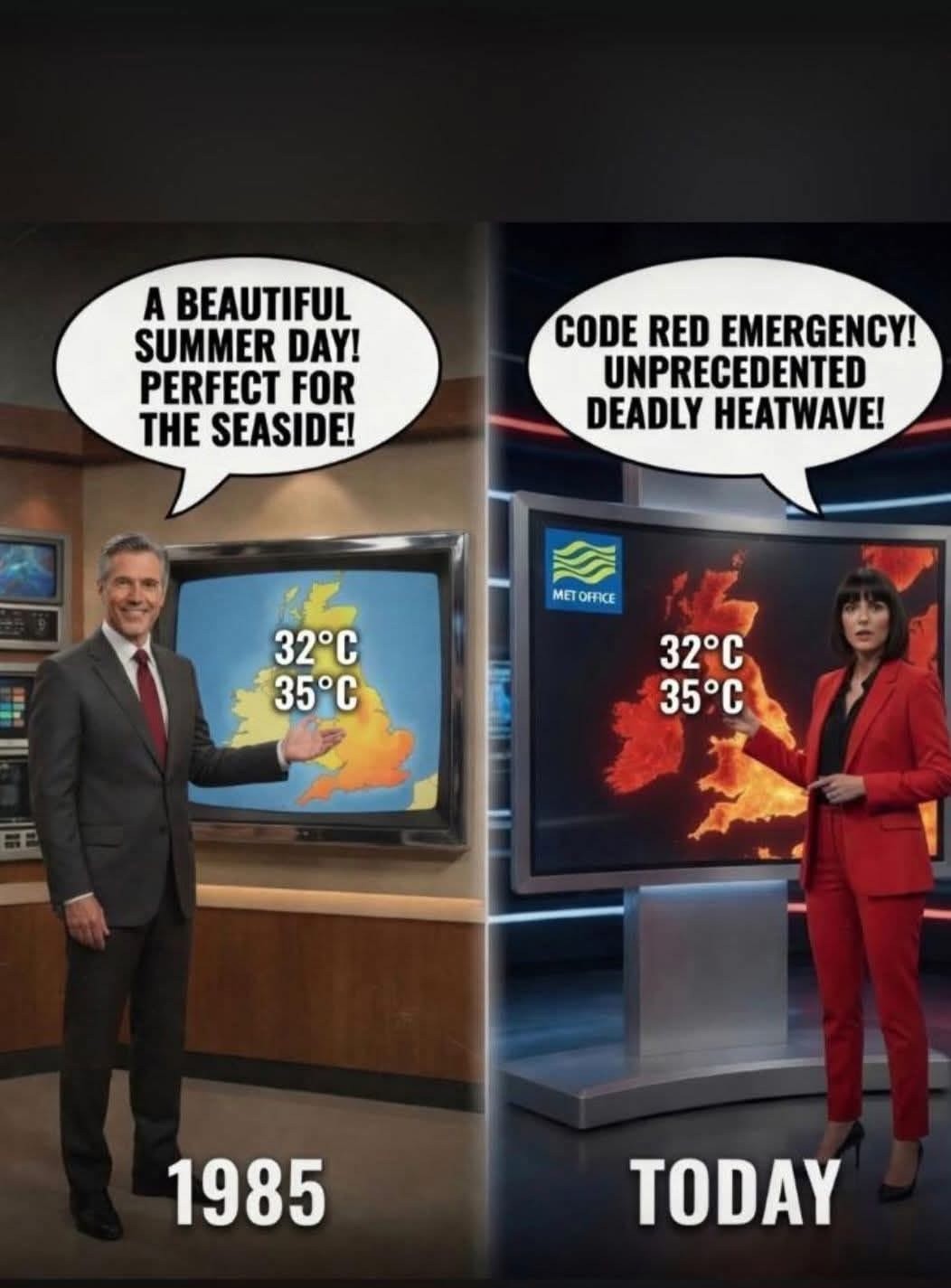
Like many people, I occasionally find myself wandering through social media’s vast landscape of misinformation, nostalgia and confidently incorrect graphics. I find it strangely enjoyable. Recently I came across a particularly impressive specimen.
The image showed two weather forecasts side by side. In the first, supposedly set in 1985, a smiling weather presenter stood in front of a map showing temperatures of 32°C and 35°C, cheerfully announcing:
“A beautiful summer day! Perfect for the seaside!”
In the second, set in the present day, a stern-looking presenter stood before an infernal red map warning of a:
“Code Red Emergency! Unprecedented deadly heatwave!”
The temperatures displayed? Exactly the same.
The message was clear. Back in the good old days Britons simply slapped on some sun cream, bought an ice cream and got on with watching Boris Becker win Wimbledon in wall to wall sunshine. Nowadays, apparently, a warm afternoon triggers national panic, emergency alerts and rolling news coverage. It’s a wonderfully effective meme. There is just one tiny problem. It’s utter twaddle.
The Trouble With The Good Old Days
The first thing that caught my eye wasn’t the temperatures. It was the year. 1985. An bizarre choice.
If you’re trying to convince people that Britain regularly basked in temperatures of 35°C without anyone batting an eyelid, there are plenty of years you could choose. 1976 would be an obvious candidate. Perhaps 2003. But 1985? That’s a bit like making a documentary about greatest players in the Premier League era and choosing me as the cover image.
Historical weather records show that 1985 was not some glorious Mediterranean summer. Quite the opposite. It was generally a rather disappointing affair, remembered in many places for being cool, wet and unsettled. The highest summer temperatures reached around 28°C. Not 35°C. Twenty-eight.
The meme isn’t comparing a modern 35°C day with a 1985 35°C day. It’s comparing a modern 35°C day with an entirely fictional 1985 35°C day. Which admittedly gives you a lot more creative freedom if you are a cretin.
Britain’s Favourite Climate: The One We Remember Incorrectly
Of course, none of this matters once nostalgia enters the room. Nostalgia is a remarkable force. It can transform school dinners into gourmet cuisine, three television channels into a golden age of entertainment and a wet British summer into the Costa del Sol.
Ask people about childhood summers and they’ll often remember endless sunshine, warm evenings and six uninterrupted weeks spent outdoors. Ask the weather records and they tend to reply, rather awkwardly, that it rained quite a lot.
Britain has always had a talent for remembering weather selectively. Every generation seems convinced that summers were hotter, winters were snowier and children spent more time outside in whichever decade they happened to be twelve years old.
The Part Where The Statistics Spoil The Fun
This is where things become genuinely interesting. Because while the meme gets 1985 spectacularly wrong, it accidentally stumbles into a real discussion about how often hot summers occur.
The UK’s official summer temperature record stretches back to 1884, while the Central England Temperature record goes all the way back to 1659, making it one of the longest continuous instrumental weather records anywhere in the world. When you examine those records, genuinely hot summers before 1976 were relatively uncommon events.
You can make a reasonable case for years such as 1911, 1921, 1933, 1947, 1949, 1959, 1975 and 1976. That’s roughly eight notably hot summers across the 92 years between 1884 and 1976.
Since 1976, however, the list becomes noticeably longer. Summers such as 1983, 1990, 1995, 1997, 2003, 2006, 2013, 2018, 2022, 2023 and 2025 all stand out. That’s eleven notably hot summers in just 49 years.
Put another way, before 1976 a truly hot summer appeared roughly once every eleven or twelve years. Since then they’ve arrived every four or five years on average. People can debate the precise membership of either list, but the overall pattern is difficult to ignore. The gaps between exceptionally warm summers have become much shorter.
The Central England Temperature series tells a similar story. Looking back over more than three and a half centuries, there have always been occasional hot summers. The difference is that many of the very warmest years are now heavily concentrated in recent decades rather than being spread evenly through the record.
The Club Nobody Expected To Join
The statistic that really catches the eye is this: all of the UK’s five warmest summers on record have occurred since 2000.
Think about that for a moment.
We’re not talking about the warmest summers since colour television. Or since decimalisation. Or since the invention of the internet. We’re talking about the warmest summers in a record stretching back to the Victorian era. That’s a fairly exclusive club and every single member has arrived in the twenty-first century.
Another simple fact is equally striking. Before 2022, the UK had never recorded a temperature of 40°C. Then, during the July 2022 heatwave, it did.
Whether one sees that as evidence of climate change, natural variability or a combination of factors, it remains a fact that would have seemed extraordinary to previous generations of British weather observers.
What Has Actually Changed?
The meme assumes that weather forecasters have become dramatically more alarmist. There is probably a little truth in the idea that modern media enjoys dramatic headlines. “Moderately Above Average Temperatures Expected” doesn’t quite generate the same excitement as “Red Alert Heat Emergency”.
But something else has changed too.
We now know far more about heat-related illness than we did forty years ago. There are more elderly people, more people living in densely built urban environments and far more evidence about the effects of prolonged heat on health, infrastructure and public services.
A forecast can still describe a lovely day at the beach while also pointing out that several consecutive days above 30°C may create risks for vulnerable people. The two ideas are not mutually exclusive.
If They Wanted A Better Meme…
If the creator really wanted to make their point, they should have used 1976. Now there was a summer, not that anyone who has a relative who lived in that period will need telling trhat.
Temperatures reached the mid-thirties. Reservoirs shrank. Lawns turned brown. Crops suffered. The country endured one of the most famous heatwaves in British history. Nobody would have needed Photoshop.
Instead they chose 1985. A year that was about as convincing an example of extreme heat as Michael Fish explaining the Great Storm of 1987 wasn’t technically a hurricane.
The Verdict
So what should we conclude from our brief excursion into Britain’s newly discovered tropical past?
First, the meme is wrong. Not slightly wrong. Not technically wrong. Completely wrong. The summer of 1985 was not a season of casual 35°C beach weather while smiling forecasters encouraged everyone to grab a bucket and spade. The historical record simply doesn’t support it.
Second, the actual weather statistics tell a far more interesting story than the meme. Looking back to 1884, hot summers were once relatively infrequent events. Since 1976 they have become noticeably more common, and all of the five warmest UK summers on record have occurred since 2000. Whatever view you take on climate change, that’s a far more remarkable fact than anything contained in the graphic.
And finally, never underestimate social media’s ability to improve the weather retrospectively. Somewhere on Facebook, Britain in 1985 apparently enjoyed endless sunshine, affordable housing, competent politicians, stress-free living and temperatures rivalling southern Spain.
The weather records only disagree with one of those claims.
I’m leaving the rest well alone.
Got something to say?