The Risk-Takers Are Back. What Could Possibly Go Wrong?
Posted on September 1, 2026
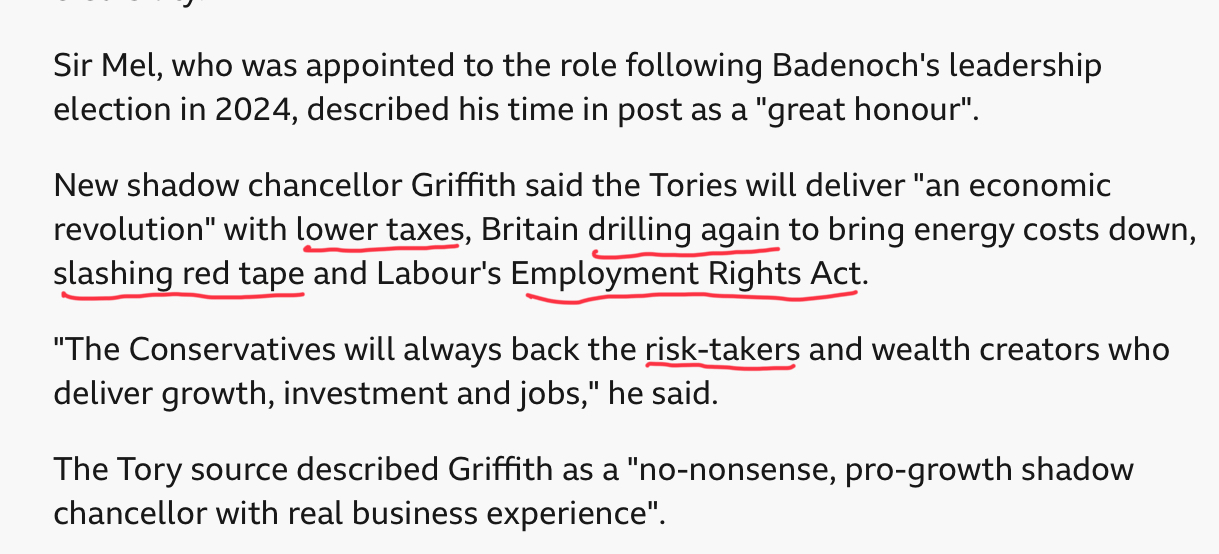
I read the latest offering from the Conservatives today and, for a brief moment, wondered whether I had accidentally stumbled across a newspaper from about 1987.
Lower taxes. Drill for oil. Slash red tape. Cut employment rights. Back the risk-takers and wealth creators.
An “economic revolution”, apparently.
Revolution?
Haven’t we already tried most of this?
Because unless I’ve completely misunderstood the last 40 years, Britain has hardly been conducting some enormous socialist experiment where everything remained safely tucked away in public ownership.
We deregulated. We privatised. We outsourced. We introduced competition. We invited private companies into public services and were repeatedly told that the magic of the market would make everything cheaper, leaner and more efficient.
So how did that go?
The Great Privatisation Adventure
There was a time when I could almost understand the argument. Almost.
Government-run organisations could be cumbersome, inefficient and wasteful. Private companies, exposed to competition and commercial discipline, might innovate, invest and provide better services for less money.
It wasn’t an entirely ridiculous theory. The problem is that we’ve now had decades to test it.
And where is the compelling evidence that handing essential public services to private monopolies, contractors and investment funds has created this promised land?
Take water.
What an extraordinary triumph of private enterprise that has been.
We sold the water companies, watched billions disappear in dividends while debt piled up, then discovered that apparently maintaining pipes, reservoirs and sewage infrastructure was the boring bit of capitalism.
There was much more fun to be had extracting money.
Now we’re paying eye-watering bills while periodically being advised not to swim in the sea because there might be a turd heading towards France. Still, at least someone took a risk.
Unfortunately, it appears the risk was ours.
Then There’s Outsourcing
We’ve spent decades outsourcing bits of the NHS, prisons, immigration, social care, transport, local government and countless other public services.
And every time something goes wrong we discover an extraordinary economic model.
The public pays. The private contractor takes its margin. If everything goes well, shareholders benefit.
If everything goes catastrophically wrong, the taxpayer picks up the pieces. I’m beginning to understand why people enjoy being “risk-takers”. It’s considerably easier when someone else is carrying the risk.
This is the bit that never seems to make it into the inspirational speeches about entrepreneurs and wealth creators.
I’m all for genuine entrepreneurs taking genuine risks with their own money. That’s capitalism. Someone inventing something, building a company, employing people and putting their own capital on the line deserves every success they get.
But running essential public infrastructure isn’t quite the same as opening a new restaurant. If your restaurant fails, I can eat somewhere else.
If the water company fails, I can’t really decide to have Evian pumped through the downstairs toilet.
And Now We Need More Deregulation?
This is the bit that really makes my head hurt.
After everything we’ve witnessed, the proposed cure is apparently less regulation.
Of course it is.
Regulation is always described as “red tape”, because that sounds irritating and pointless.
Nobody ever announces that they’re going to slash “rules preventing companies from behaving like absolute bastards”.
That wouldn’t poll quite so well.
Some regulation undoubtedly becomes outdated, bureaucratic or unnecessary and should be removed. Nobody sensible wants businesses buried under pointless paperwork.
But regulations generally exist because somewhere, at some point, somebody took the piss. Employment law exists because workers once had virtually no protection.
Financial regulation exists because financial institutions have demonstrated an occasional tendency to become rather excited and blow themselves up.
Environmental regulation exists because pouring shit into rivers is considerably cheaper than treating it.
Health and safety legislation exists because sending someone 40 feet up a ladder balanced on a wheelie bin is wonderfully efficient until they land in the car park.
Calling all of this “red tape” is wonderfully convenient.
And What Exactly Are We Risking?
This obsession with “risk-takers” bothers me most when we’re talking about essential services.
What risks would we like them to take? A punt with the NHS?bA little experiment with the prison system? Perhaps roll the dice with drinking water?
Maybe remove a few troublesome employment protections and see what happens?
We’ve spent years watching public services starved of investment whilst governments of various colours desperately try to work out how to repair systems fragmented by outsourcing, short-term contracts and chronic underinvestment.
And now we’re supposed to believe that another blast of deregulation and private-sector risk-taking is going to sort everything out.
At what point do we stop calling this an economic philosophy and start calling it repeatedly putting your hand on the same electric fence?
Who Actually Gets the Reward?
That’s ultimately the question. Who benefits?
Because whilst it might once have been believable that privatisation, deregulation and encouraging private companies to take over public services would unleash efficiency and innovation, we’ve now got decades of evidence to examine.
And I struggle to see compelling evidence that doing it all again would benefit anyone other than a relatively small collection of directors, investors and shareholders.
The profits are private. The consequences have an irritating habit of becoming public.
And stripping workers of rights in the name of “growth” doesn’t suddenly make Britain more productive. It just alters the balance of power between people who employ and people who are employed.
There are plenty of things Britain desperately needs.
Investment. Infrastructure Better productivity. Affordable energy. A functioning NHS. Clean rivers. Decent public transport. Businesses encouraged to grow and employ people.
None of those things requires us to pretend we’ve forgotten everything that’s happened since the 1980s.
Maybe genuine economic revolution would involve learning from the last one.
Because if somebody tells me that the answer to failing privatised services, crumbling infrastructure and public frustration is more deregulation, more risk-taking and fewer employment rights, I’m entitled to ask one fairly basic question.
Are we really going to fall for this shit again?
Paul Weller probably summed up the relationship between power and ordinary people rather better than any politician ever will, and that was four decades ago.
“Those who play the power game, they take the profits, you take the blame.”
Norman House
September 2, 2026 (8:03 am)
100% agree on all of that!