Water, Water Everywhere. Except Where We Actually Need It
Posted on August 14, 2026
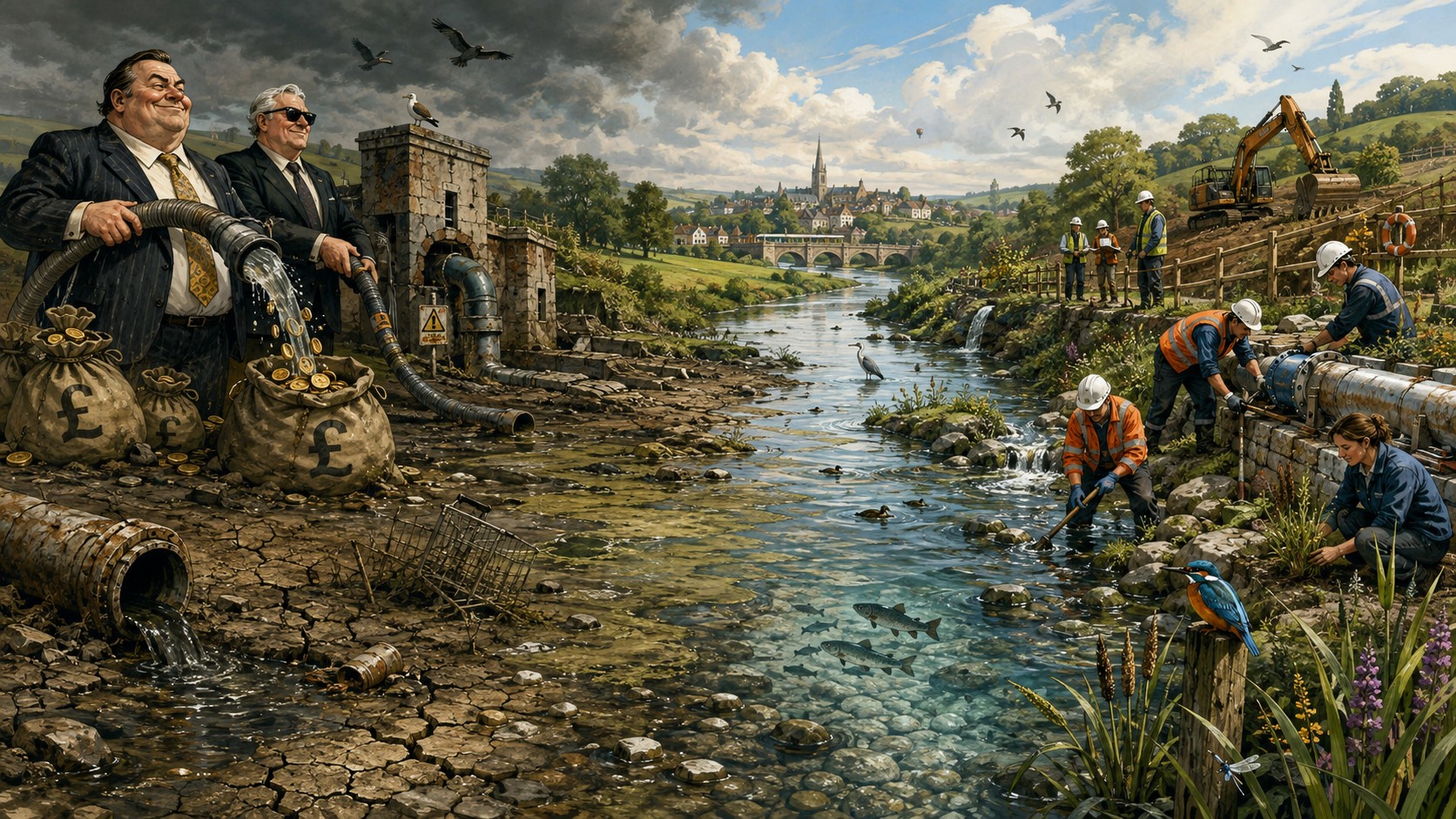
I was speaking to an old mate of mine, Gwylim, last night. He works for the Kennet & Avon Trust, so he knows a thing or two. Britain’s rivers are in trouble. big trouble. We can keep pretending the present system just needs another stern letter from Ofwat, or we can start treating water as the national infrastructure it actually is.
There is a peculiar argument that appears whenever anyone suggests taking Britain’s water companies back into public ownership.
“We can’t afford it.”
This is generally delivered as if governments operate like a bloke standing at the Tesco checkout discovering he has left his wallet at home.
They don’t.
The British government can borrow money. It does so constantly, principally by issuing government bonds, known as gilts, through the Debt Management Office. Public borrowing is not some obscure Venezuelan financial experiment. It is one of the basic mechanisms by which modern governments finance themselves.
So yes, a government determined to return the water industry to public ownership could do it.
It wouldn’t be simple. It wouldn’t be free. There would be ferocious arguments over compensation, company debt, pension liabilities and precisely what assets were being transferred.
But “difficult” and “impossible” are two entirely different things.
So how could it actually work?
Parliament could pass legislation transferring the shares or assets of water companies into public ownership.
There is nothing constitutionally mystical about nationalisation. Parliament is currently using precisely this sort of legislative mechanism in the steel industry, with provisions allowing shares or property to be transferred into public ownership where ministers believe it is in the public interest.
Compensation would be one of the great battles.
Property rights are protected under the European Convention on Human Rights, but they are not an absolute prohibition on nationalisation. Governments have considerable scope to act in the public interest, although the terms of compensation would need to survive legal scrutiny.
In other words, the government probably couldn’t just turn up at Thames Water with a Transit van and announce that everything now belongs to Steve from DEFRA.
There would need to be legislation, valuations and a defensible compensation mechanism.
The government could then finance whatever acquisition cost was agreed through borrowing. That borrowing would increase public liabilities, which matters. Interest would have to be paid.
But something else would also happen.
The public would acquire an asset.
That distinction seems to disappear from political debate surprisingly often.
Borrowing £20 billion to consume £20 billion is different from borrowing £20 billion to acquire infrastructure that produces revenue for decades. The government’s balance sheet gains both a liability and an asset.
The exact cost of nationalising water is hugely disputed. A government response in 2024 cited research estimating about £90 billion, while campaigners and supporters of public ownership argue that substantially lower valuations could be justified once debts and company circumstances were considered.
So anyone confidently telling you it would cost precisely £X billion is probably displaying rather more certainty than the subject deserves.
And then what?
This is the bit that matters.
People would still pay water bills.
Engineers would still be paid. Treatment works would still operate. Pipes would still need replacing. Reservoirs would still need maintaining. Debt would still need servicing.
Public ownership does not mean water suddenly becomes free because the chancellor has found a magic tap behind the Treasury.
The difference is what happens to the money after the essential costs are covered.
A publicly owned water system could be structured so that surpluses were returned to the network rather than distributed to private shareholders.
That means reservoirs.
Pipes.
Sewage treatment works.
Leak reduction.
Flood resilience.
Chalk streams.
River restoration.
Water security.
And the colossal amount of infrastructure Britain is going to need as the climate changes and the population grows.
Even under the existing system, Ofwat has approved a £104 billion investment programme for 2025 to 2030 to improve water supplies, rivers and seas. So nobody seriously disputes that staggering amounts of investment are required.
The argument is about who owns the system, how that investment is financed and where the rewards ultimately go.
How did we end up here?
In 1989 Margaret Thatcher’s government privatised the ten publicly owned regional water and sewerage authorities in England and Wales, transferring their assets and staff into private companies.
At the time it was sold as a way of bringing private capital and efficiency into an industry requiring major investment.
More than three decades later, it is reasonable to ask whether the experiment has worked.
Indeed, Parliament’s Environment, Food and Rural Affairs Committee concluded in 2025 that “root and branch reform” of the sector was required, highlighting poor financial management, unsustainable debt and environmental failures.
The Environment Agency’s assessment of water company environmental performance in 2024 was equally cheerful reading if you enjoy books about industrial decline.
The nine English water and sewerage companies collectively achieved their lowest overall environmental rating since the assessment system began in 2011.
There were still 291,492 recorded storm-overflow spill events in England in 2025. That was a significant improvement on 2024, but it is hardly a figure you’d embroider on a cushion.
The strange politics of wanting clean rivers
What I find increasingly bizarre is that concern about rivers, wildlife and water security has somehow become tangled up in the culture wars.
There appears to be a particular strain of right-wing thinking where worrying about collapsing ecosystems immediately makes you a tofu-eating woke snowflake who is probably plotting to replace the Union Jack with a picture of a newt.
It is utterly ridiculous. Wanting a functioning river isn’t left wing and and asking for sewage to be properly treated isn’t Marxism. Hoping for enough clean water for our children and grandchildren isn’t the extremist environmental agenda.
It’s plumbing. And survival.
Sometimes I wonder whether part of the denial comes from the uncomfortable political history behind it.
Because acknowledging the scale of the problem eventually requires us to ask whether privatising something as fundamental as water was such a brilliant idea after all.
For those who have spent forty years treating Thatcherism less as a political philosophy and more as holy scripture, that is presumably an awkward conversation. You can’t speak ill of the dead people who let you buy your council house.
Try and watch the abuse you get.
This isn’t just about pretty rivers
That is the other mistake.
People see environmental collapse as something involving a few unfortunate fish and a disappointed bloke with binoculars. It isn’t.
Healthy rivers support wildlife, agriculture, recreation, fishing, local businesses and tourism. They recharge aquifers and form part of the system from which our drinking water ultimately comes.
Safe and readily available water is fundamental to public health and economic activity. When a river system begins collapsing, the kingfisher disappearing is the bit we notice.
Then the fish go, along with insects, followed by plants. Then businesses dependent on recreation and tourism start struggling and eventually maintaining water quality becomes more difficult and expensive.
Eventually you arrive at the small administrative inconvenience of human beings needing clean water every single day in order not to die.
This is why I struggle when environmental protection gets presented as a lifestyle choice, somewhere between joining the National Trust and buying an air fryer.
Water security is national security.
A national crisis requires a national response
Renationalisation wouldn’t instantly clean every river.
Public bodies can be inefficient as well. Governments can make dreadful investment decisions. Politicians can kick difficult infrastructure spending down the road just as enthusiastically as private companies do.
Public ownership is not fairy dust.
It would need genuinely independent regulation, long-term investment plans protected from election cycles, competent management and legislation ensuring that money generated by the industry was overwhelmingly reinvested in water infrastructure and environmental recovery.
And yes, it would involve borrowing. Quite possibly a lot of it. But Britain has repeatedly borrowed enormous sums when governments decided something was sufficiently important.
The real argument, therefore, isn’t whether we can do it.
It is whether we believe securing our water supply and stopping the ecological degradation of our rivers is important enough to do it.
I think we’re rapidly reaching the point where the answer should be obvious. The politicians need to wake up and public needs to wake up. And those still fighting some imaginary culture war where protecting a chalk stream is apparently communism particularly need to wake up.
Because rivers don’t care whether you vote Labour, Conservative, Reform, Green or for a bloke called Trevor who stood as an independent because he was angry about the bypass. When an ecosystem collapses, it collapses for everyone.
And when clean water becomes scarce, nature won’t be terribly interested in hearing whose fault you thought it was on Facebook.
Water isn’t a luxury. Rivers aren’t ornamental. Biodiversity isn’t woke. We can argue about exactly how public ownership should work, what it would cost and how quickly it could be achieved.
But pretending the current situation can drift on indefinitely is no longer a serious option.
It’s time to wake up.
Got something to say?